
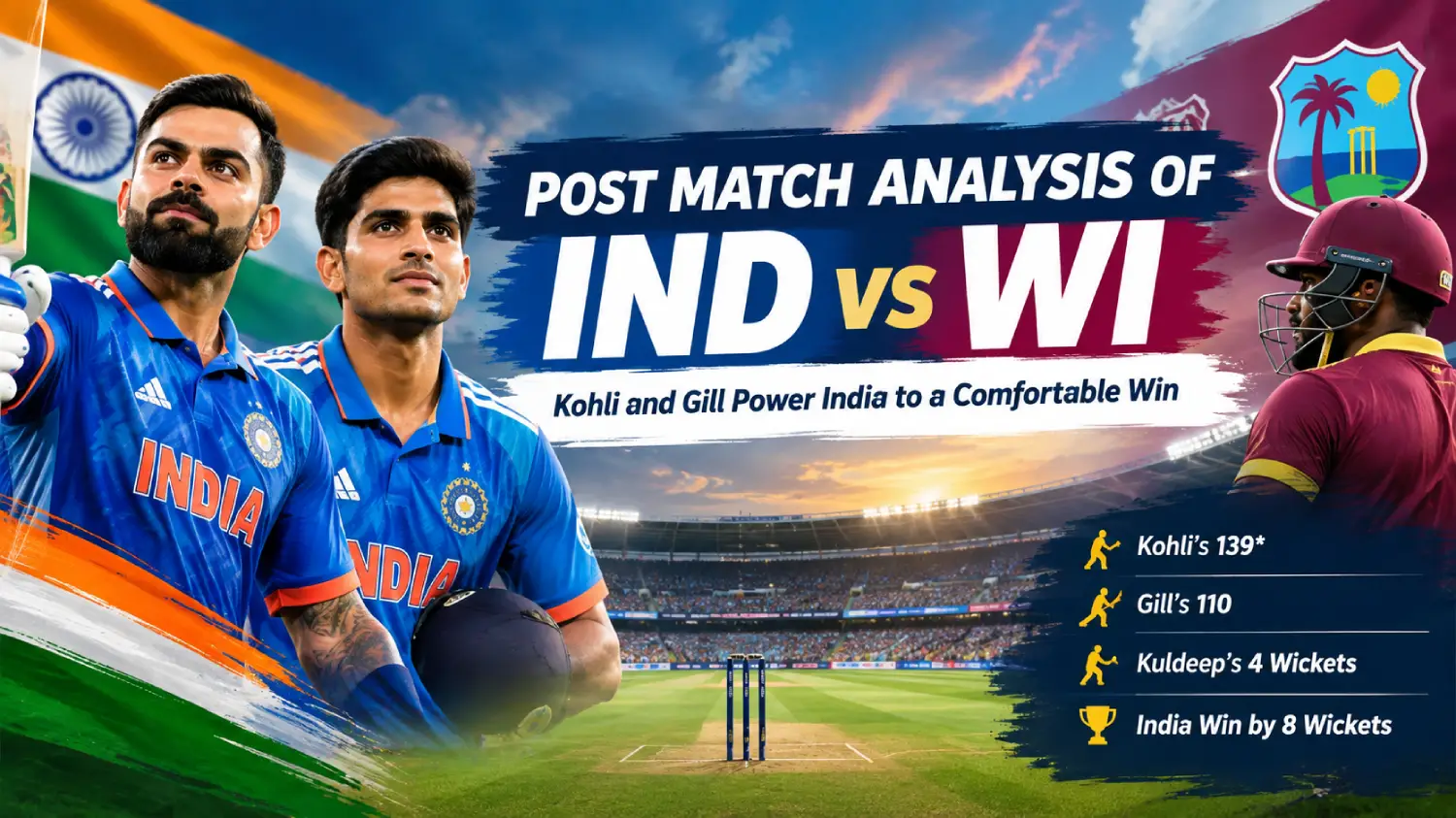

The post match analysis of IND vs WI begins with a simple conclusion: India were tested by the West Indies, but they never looked out of control for long. After the visitors posted 295 for seven in the first ODI at Greenfield Stadium, Thiruvananthapuram, India chased down the target in just 41.4 overs, winning by eight wickets with 8.2 overs to spare.
The match had everything a one-day international promises: an impressive century from Justin Greaves, a disciplined spell from Kuldeep Yadav, sparkling strokeplay from Shubman Gill and another record-breaking performance from Virat Kohli. India eventually finished on 300 for two, taking a 1-0 lead in the three-match series.
For the West Indies, the defeat will be disappointing because they had built a strong platform. For India, it was an encouraging start to the series and another reminder of the batting depth and match awareness within the side.
Post Match Analysis of IND vs WI: West Indies Build a Competitive Total
The West Indies began their innings positively. Their opening partnership crossed 100 runs and gave the visiting side the ideal foundation. Justin Greaves made the most of the opportunity, scoring an excellent 101 from 108 balls.
Greaves’ century was built on patience and clean strokeplay. He struck 12 fours and kept the scoreboard moving during the middle overs. His innings gave the West Indies a realistic chance of putting India under pressure in the chase.
However, the West Indies struggled to maintain the same momentum after the opening partnership was broken. India’s bowlers gradually slowed the scoring rate, and the visitors lost wickets at important stages.
The West Indies eventually reached 295 for seven. It was a competitive total, but the score may have felt slightly below par after such a promising start. A stronger finish could have given their bowlers a larger cushion against India’s experienced batting line-up.
How Kuldeep Yadav Changes the Momentum
The most important bowling performance for India came from Kuldeep Yadav. His spin became increasingly difficult to attack as the West Indies moved into the middle overs. This acts as an asset for bettors who are more engaged in in-play cricket betting.
Kuldeep claimed four wickets and played a central role in restricting the visitors. His spell interrupted the West Indies’ rhythm just when they appeared capable of reaching an even higher total. This arm-twist spinner provides a mathematical advantage for the bettors over a dynamic bookmaker.
This was a classic example of how middle-over bowling can shape an ODI. The opening batters create the platform, but the middle overs often decide whether a team finishes with 280, 295 or more than 320. Kuldeep’s ability to take wickets while controlling the scoring rate prevented the West Indies from producing a more threatening total.
In the post-match analysis of IND vs WI, Kuldeep’s contribution deserves particular attention because his wickets allowed India to begin the chase with a manageable target rather than a daunting one.
India’s Chase Starts with Rohit Sharma
India’s chase began with Rohit Sharma and Shubman Gill at the top of the order. Rohit did not appear to be at his fluent best, and the West Indies bowlers managed to build pressure against him.
Alzarri Joseph bowled several disciplined deliveries to Rohit before eventually forcing him to play towards deep mid-wicket. India lost their first wicket after an opening stand worth 74 runs from 12 overs.
Although Rohit’s dismissal brought Virat Kohli to the crease, India were still in a comfortable position. The early partnership had provided stability, and the required rate was well within reach.
The key for India was to avoid losing another quick wicket. Instead, Kohli joined Gill and ensured that the chase continued to move forward.
Kohli and Gill Take Control
Shubman Gill played the role of an assured captain. He scored 110 from 108 balls, including 13 fours and one six. His innings was not only important for the scoreboard but also for the confidence it brought to the chase.
Gill had an opportunity early in his innings when substitute fielder Keemo Paul dropped him off Jayden Seales. That missed chance proved costly for the West Indies. Gill made full use of the reprieve and went on to complete a valuable century.
His partnership with Kohli became the turning point of the match. The pair added 151 runs for the second wicket from only 132 balls. They combined sensible shot selection with aggressive running and boundary-hitting, leaving the West Indies bowlers with very few opportunities to build pressure.
Gill’s hundred also reflected his growing maturity as a batter and leader. He did not rush the chase, but he did not allow the required rate to become a concern either.
Kohli Produces Another Masterclass
Virat Kohli’s unbeaten 139 off 88 balls was the defining performance of the match. He hit 10 fours and nine sixes, attacking the bowling with a level of confidence that made the chase appear almost effortless.
Kohli initially played himself in, rotating the strike and supporting Gill. Once he became comfortable, his innings moved into a different gear. He targeted the gaps, picked up boundaries behind square and began clearing the ropes with remarkable authority.
The moment he reached his century was especially memorable. Kohli brought up his 55th ODI hundred with a towering six off Gudakesh Motie over long-on. It was an appropriate finish to an innings that had combined control with power.
The post match analysis of IND vs WI cannot overlook the way Kohli changed the tone of the game. The West Indies had posted a respectable total, but Kohli’s attacking approach removed much of the pressure from India’s chase.
A Historic Milestone for Virat Kohli
Kohli’s century was significant beyond the result. During his innings, he crossed 15,000 runs in ODI cricket.
He became only the second batter in history to reach the landmark after Sachin Tendulkar. The achievement adds another remarkable chapter to Kohli’s already extraordinary limited-overs career.
The milestone carried an emotional connection as well. Kohli reached the landmark with Shubman Gill at the other end—a younger Indian batter who is increasingly seen as one of the central figures in the next phase of Indian cricket.
In many ways, the moment represented a link between two generations. Tendulkar’s influence shaped Kohli’s career, and Kohli’s experience is now helping define the environment in which Gill and other young Indian players are developing.
Why the West Indies Lost
The West Indies did several things well, but three moments worked against them.
First, they could not convert their excellent opening partnership into a much bigger total. Reaching 295 was respectable, but the pitch and the start suggested that more runs may have been available.
Second, Kuldeep Yadav disrupted the middle overs. Losing wickets during that phase prevented the visitors from finishing with the acceleration they needed.
Third, the dropped chance involving Gill proved expensive. A batter of Gill’s quality cannot be given an additional opportunity during a chase, particularly when Virat Kohli is batting at the other end.
The West Indies will also need to review their death-overs bowling. Once Gill and Kohli settled in, the bowlers struggled to create dot-ball pressure or force mistakes. India’s batters were able to find boundaries without taking excessive risks.
India’s Strengths and Areas to Improve
India’s biggest strength was the way the team responded after conceding a good start to the West Indies. Kuldeep’s spell restricted the total, while the top order handled the chase with confidence.
Gill’s century was important from a leadership perspective, and Kohli’s unbeaten knock showed that he remains capable of dominating ODI cricket. The partnership between the two batters also reduced the workload on India’s middle order.
However, India may still want more consistency from the opening combination. Rohit Sharma’s early dismissal after a subdued stay at the crease suggests that the top order is not yet operating at its most fluent level.
India’s fielding and bowling at the death could also be examined. Although the target was defended successfully in the broader context of the match, allowing a strong opening partnership and missing a chance against Gill gave the West Indies opportunities they could not exploit.
What This Result Means for the Series
India now lead the three-match ODI series 1-0. The result gives the team confidence, but the West Indies still have reasons to believe they can compete in the remaining matches.
Justin Greaves’ century showed that the visitors possess batters capable of handling India’s bowling attack. Their challenge will be to sustain partnerships, finish innings more strongly and take chances when they come.
India, meanwhile, will want to continue developing the balance between experienced players and emerging leaders. Gill’s century as captain and Kohli’s record-breaking performance provided the perfect combination of present reliability and future promise.
The second ODI may bring different conditions and a fresh contest, but the West Indies will need a sharper plan for Kohli. Allowing him to settle into a chase can quickly turn a competitive match into a one-sided result.
Read More Blogs :
1. T20 Cricket This Week
2. India vs Afghanistan T20I
Frequently Asked Questions
What was the result of the first IND vs WI ODI?
India defeated the West Indies by eight wickets in the opening ODI at Greenfield Stadium in Thiruvananthapuram. India scored 300 for two in 41.4 overs while chasing the West Indies’ 295 for seven.
Who scored centuries in the match?
Justin Greaves scored 101 for the West Indies. India’s Shubman Gill scored 110, while Virat Kohli remained unbeaten on 139.
How many runs did Virat Kohli score?
Virat Kohli scored 139 not out from 88 balls. His innings included 10 fours and nine sixes.
How many wickets did Kuldeep Yadav take?
Kuldeep Yadav claimed four wickets and played a crucial role in restricting the West Indies during the middle overs.
What milestone did Virat Kohli achieve?
Kohli crossed 15,000 ODI runs during his innings. He also scored his 55th ODI century.
Final Verdict
The post match analysis of IND vs WI shows a match that was competitive in the first innings but firmly controlled by India during the chase. The West Indies had a strong beginning through Justin Greaves, yet Kuldeep Yadav’s four-wicket spell prevented them from reaching a more imposing total.
India then produced a composed and dominant response. Shubman Gill’s 110 provided the foundation, while Virat Kohli’s unbeaten 139 finished the contest in spectacular fashion.
The match will be remembered for Kohli’s 55th ODI century and his crossing of 15,000 ODI runs. But it also highlighted India’s broader strength: reliable top-order batting, effective middle-over bowling and the ability to turn pressure into control. For the West Indies, the next match will require better execution in the middle overs, sharper fielding and a plan capable of stopping India’s experienced run chasers.
[ Log In Our Website ]